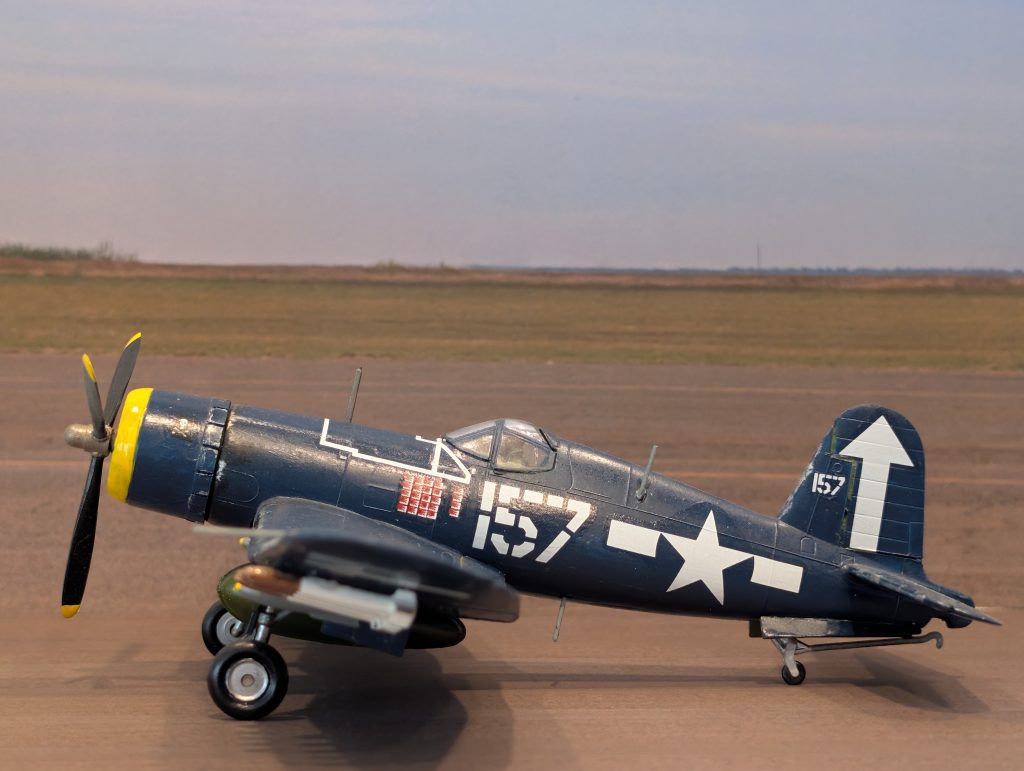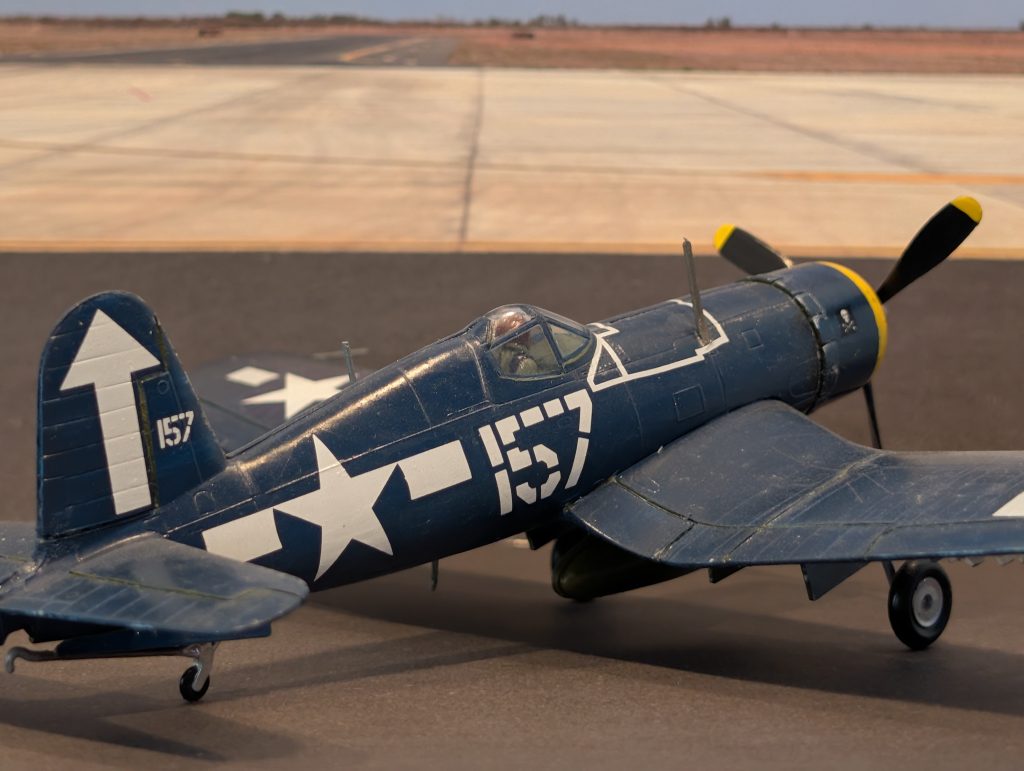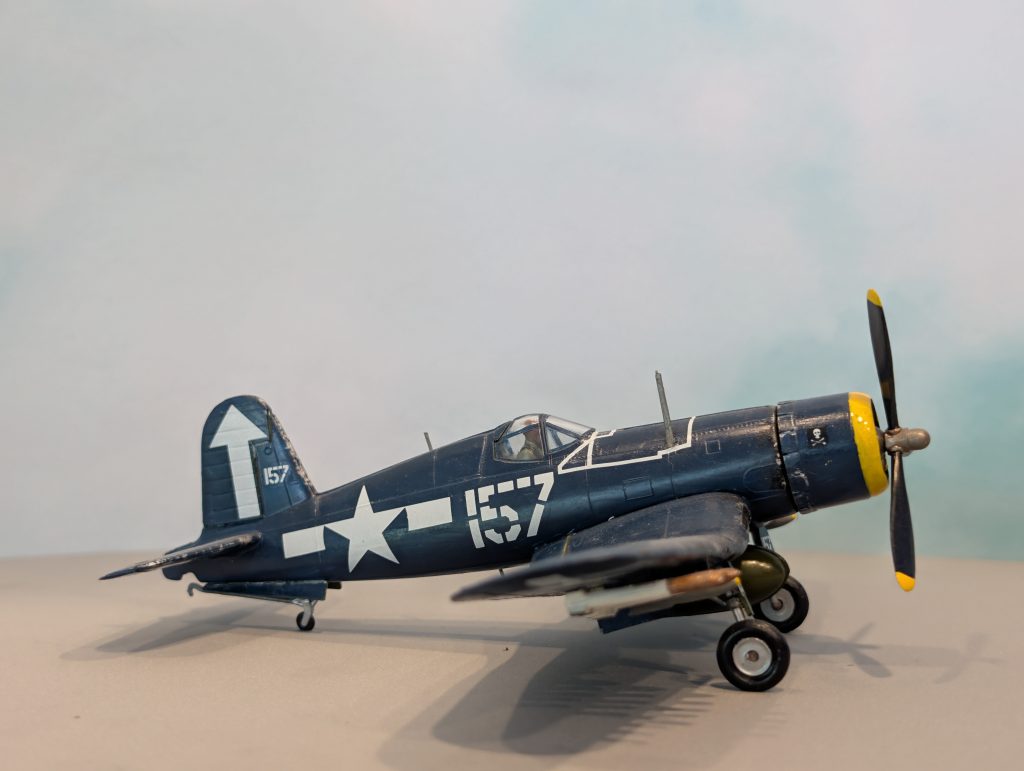
Vought F4U-1D Corsair “White 157”
The legendary Vought F4U-1D Corsair was one of the most recognizable and capable American naval fighters of World War II.
The Corsair was designed around the powerful Pratt & Whitney R-2800 Double Wasp radial engine and its enormous 13-foot Hamilton Standard propeller. To provide enough ground clearance for that propeller while keeping the landing gear relatively short and strong, Vought gave the aircraft its unmistakable inverted gull wing. Combined with a streamlined fuselage, the design produced one of the fastest piston-engine fighters of the war.
The Corsair’s performance came with challenges. Early F4U variants had poor forward visibility during landing, powerful torque effects, and difficult carrier-handling characteristics. These issues initially kept the Corsair from routine carrier operations, and many early aircraft were assigned to land-based U.S. Marine Corps squadrons in the Pacific. Improvements in later versions, together with better carrier-landing techniques, eventually allowed the aircraft to return to U.S. Navy carrier decks in large numbers.
During World War II, the Corsair served as both an air-superiority fighter and a highly effective fighter-bomber. Its six .50-caliber Browning machine guns, strong airframe, speed, range, and ability to carry bombs or rockets made it useful for escort missions, combat air patrol, strafing, close air support, anti-shipping attacks, and strikes against Japanese airfields and ground positions. By the end of the war, U.S. Navy records credited Corsair pilots with 2,140 enemy aircraft destroyed in aerial combat and an 11-to-1 kill ratio.
The F4U-1D was one of the most important late-war Corsair variants. It retained the six-machine-gun armament of the earlier fighter versions while adding improved fighter-bomber capability, including provisions for external bombs, drop tanks, and rockets. By 1945, the Corsair had become a major component of fast-carrier air groups operating against Japan, Iwo Jima, Okinawa, and targets throughout the Western Pacific.
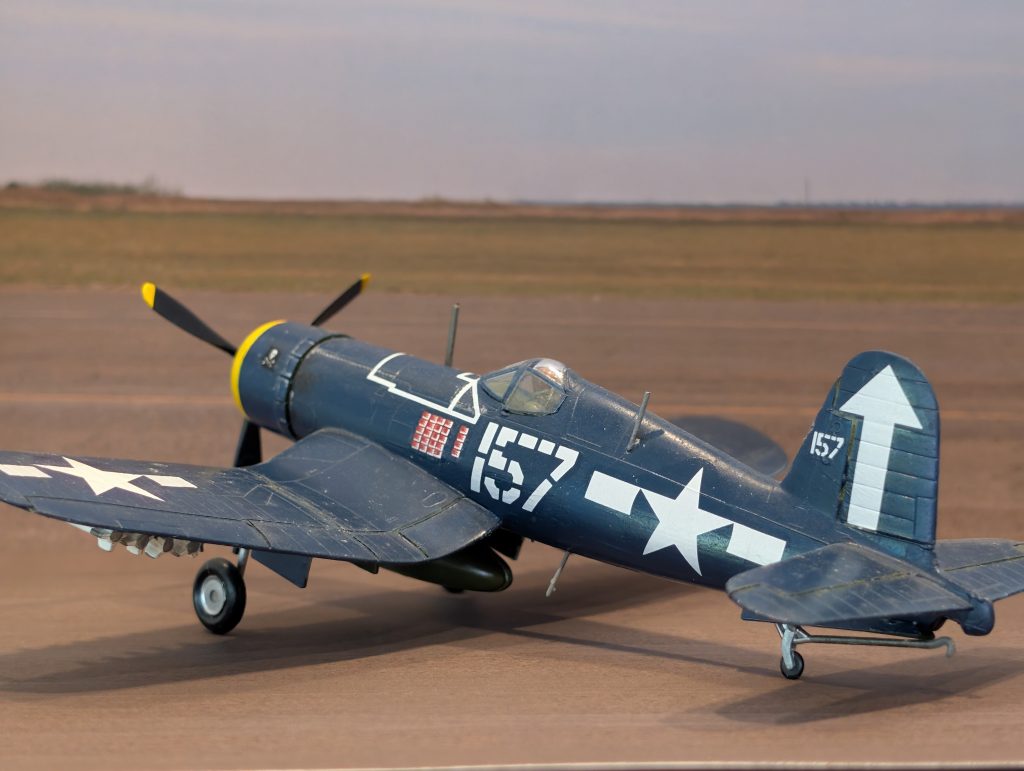
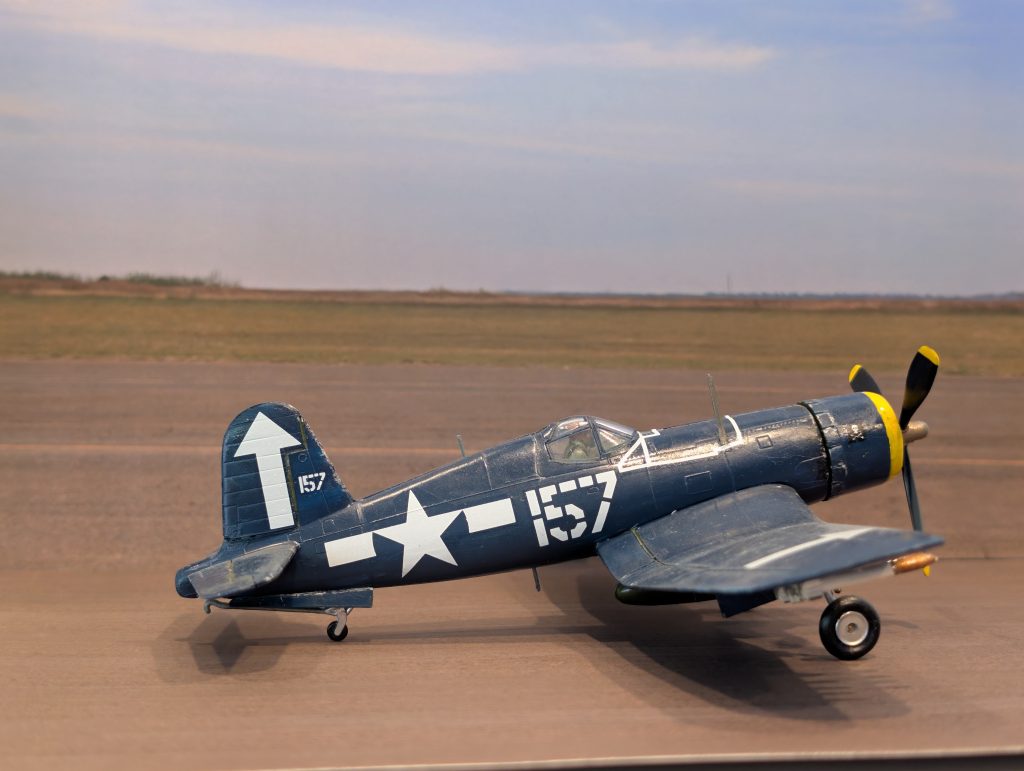
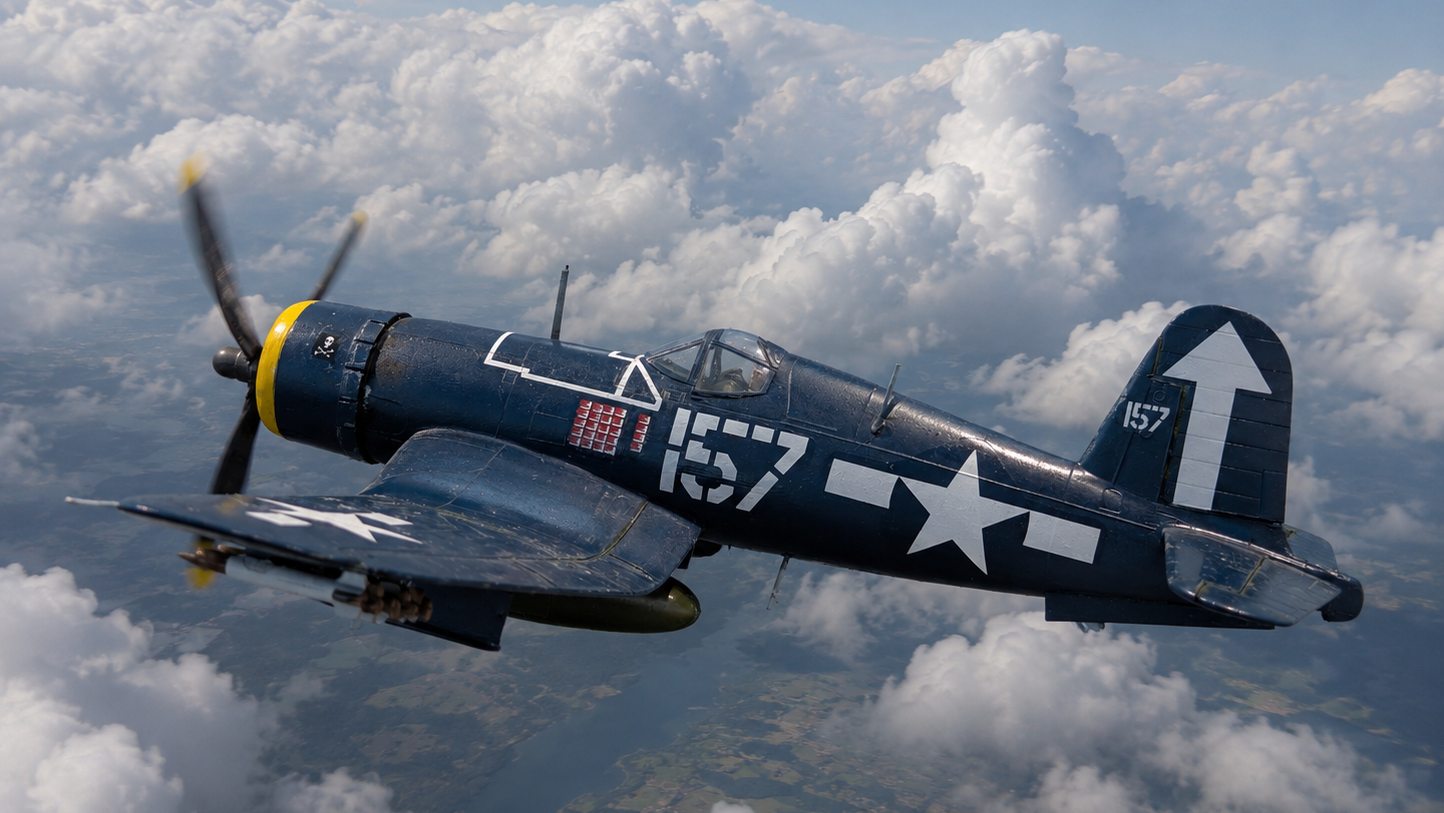
This particular model represents “White 157,” an F4U-1D of VF-84, known as the “Wolf Gang.” VF-84 operated from the aircraft carrier USS Bunker Hill as part of Carrier Air Group 84 during the final major campaigns of the Pacific War. The squadron flew Corsairs in support of strikes against Japan, the invasion of Iwo Jima, and the Okinawa campaign. The large white arrow on the vertical tail and the aircraft number “157” are characteristic of the unit’s early-1945 carrier markings.
It is worth noting that this wartime VF-84 “Wolf Gang” was not the same squadron as the later F-14 Tomcat unit known as the “Jolly Rogers.” The U.S. Navy reused squadron designations over time, but the World War II VF-84 was established in 1944 and disestablished shortly after the war.
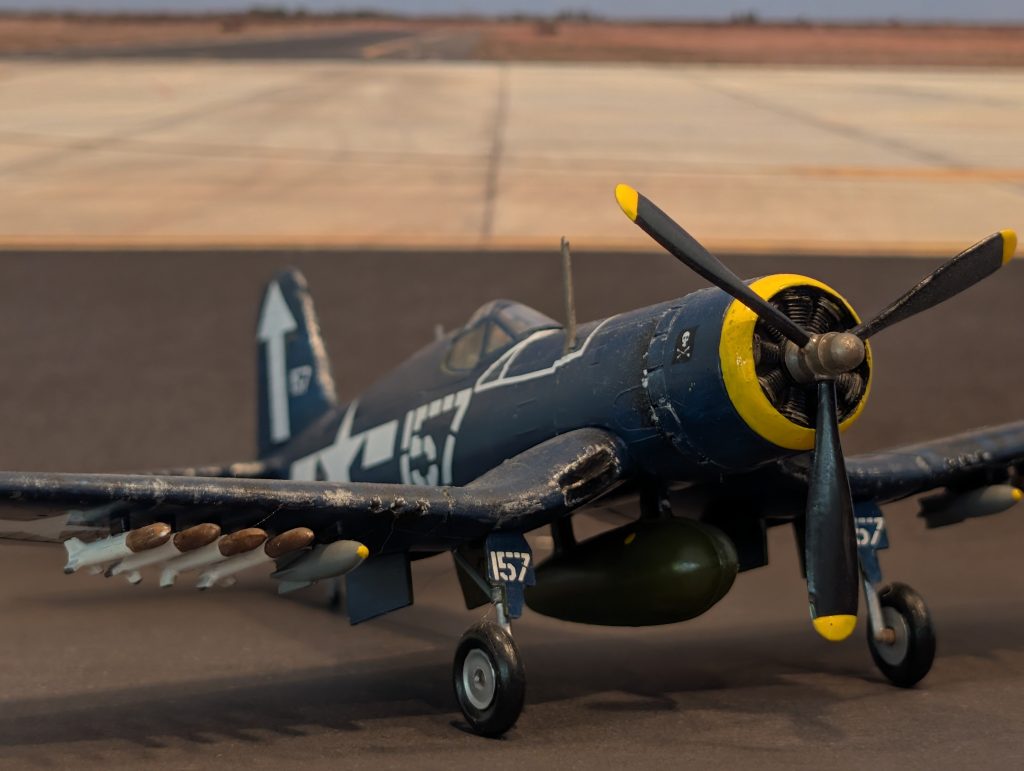
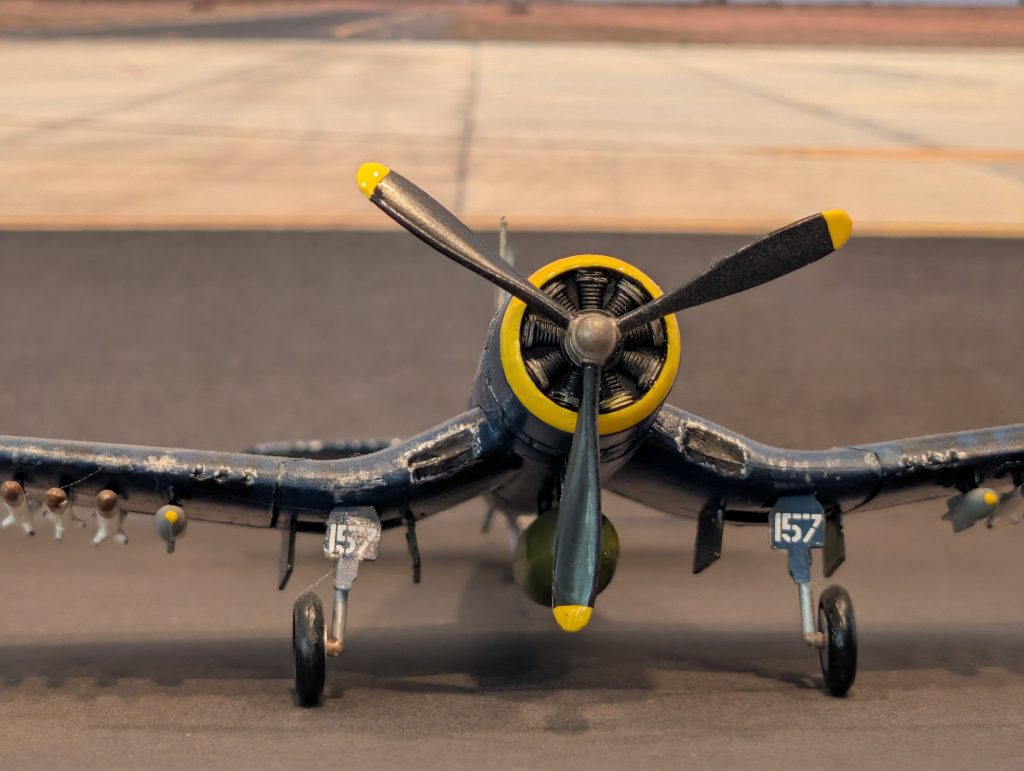
The Corsair’s combat career did not end in 1945. It returned to service during the Korean War, where Navy and Marine Corps Corsairs operated from carriers and forward airfields. By then, jet fighters dominated high-altitude air combat, so the Corsair’s primary mission became close air support for Allied troops on the ground. Corsairs delivered rockets, bombs, napalm, and cannon fire against enemy positions, supply routes, artillery sites, and troop concentrations. A Marine F4U pilot, Captain Jesse Folmar of VMF-312, even shot down a MiG-15 in September 1952—one of the rare air-to-air victories achieved by the type during the conflict.
After Korea, the Corsair continued serving internationally. France received the final production version, the F4U-7, for its naval aviation arm. French Corsairs later saw combat in Indochina, during the Suez Crisis, and in Algeria. The last Corsairs remained in military service well after the age of piston-engine fighters had largely passed.
This 1/72 scale model pays tribute to the F4U-1D Corsair “White 157,” the pilots and deck crews of VF-84 “Wolf Gang,” and the men of USS Bunker Hill who operated one of the most distinctive and formidable naval fighters of World War II.
The Reference Material
Historical sources:
Smithsonian National Air and Space Museum; Naval History and Heritage Command; National Museum of the Marine Corps. Marking reference for F4U-1D “White 157”: period-photo archive of VF-84 Corsairs aboard USS Bunker Hill. U.S. National Archives (NARA)
The Vought F4U-1D Corsair – General Specifications
- Role: Carrier-capable fighter-bomber
- Crew: 1 pilot
- Powerplant: 1 × Pratt & Whitney R-2800-8W Double Wasp
- Engine type: 18-cylinder, two-row, air-cooled radial; two-stage, two-speed supercharger
- Takeoff power: 2,000 hp at 2,700 rpm
- Combat / water-injection power: 2,250 hp at sea level, 2,700 rpm
- Propeller: Three-blade Hamilton Standard constant-speed propeller
- Propeller diameter: 13 ft 1 in / 3.99 m
- Wingspan: 40 ft 11.73 in / 12.49 m
- Wingspan, folded: 17 ft 0.50 in / 5.19 m
- Length: 33 ft 4.125 in / 10.16 m
- Height to tail thrust-line level: 15 ft 1.28 in / 4.60 m
- Wing area: 314 sq ft / 29.17 m²
- Empty weight, actual BuAer figure: 9,014 lb / 4,089 kg
- Empty weight, Vought design estimate: 8,823 lb / 4,002 kg
- Standard combat gross weight: 12,175 lb / 5,522 kg
- Long-range fighter gross weight: 14,370 lb / 6,518 kg
- Internal fuel: 237 U.S. gal / 897 L
- Maximum listed ferry fuel arrangement: 712 U.S. gal / 2,695 L
- External tank arrangement: Two 150-gal wing tanks plus one 175-gal centerline tank
Performance:
- Maximum speed at sea level: 358 mph / 576 km/h, combat power
- Maximum speed at critical altitude: 409 mph / 658 km/h at 19,900 ft, combat power
- Alternate Vought fighter estimate: 416 mph / 669 km/h at 20,000 ft, war-emergency power
- Initial rate of climb: 3,370 ft/min / 17.1 m/s, combat power
- Time to 10,000 ft: 3.2 minutes
- Time to 20,000 ft: 7.1 minutes
- Service ceiling: 41,000 ft / 12,497 m, combat power
- Stall speed at 12,175 lb: 87.5 mph / 141 km/h
- Maximum operational planning range: 980 statute miles / 1,577 km at 182 mph, in the BuAer normal-power condition
Armament:
- Fixed guns: 6 × .50-caliber / 12.7 mm machine guns
- Ammunition: 2,400 rounds total
- Wing bomb provisions: 2 × 1,000 lb, 2 × 500 lb, 2 × 250 lb, or 6 × 100 lb bombs
- Centerline bomb provision: 1 × 1,000 lb, 1 × 500 lb, or 1 × 250 lb bomb
- Rocket load: Up to 8 × 5-inch HVARs or 5-inch aircraft rockets
- Heavy rocket option: 2 × 11.75-inch aerial rockets, in place of drop tanks